


Where To Place A Tourniquet?
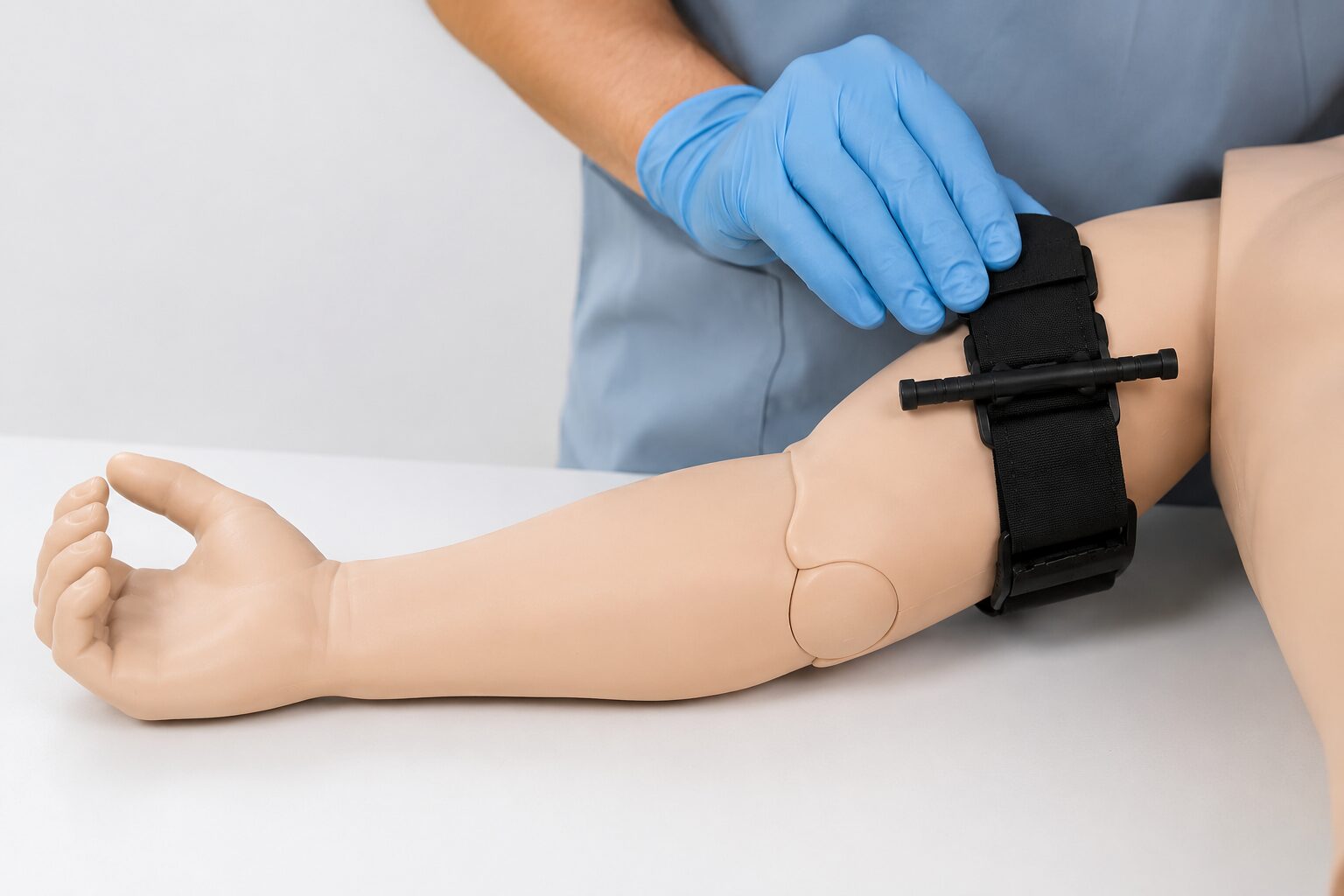
Where to place a tourniquet depends on its intended use. For life-threatening limb bleeding, an emergency tourniquet is generally placed 2–3 inches above the wound and never over a joint. For venipuncture, a clinical elastic tourniquet is normally positioned above the selected puncture site to make the vein easier to identify, following the healthcare facility’s procedure.
Tourniquets used for trauma and tourniquets used for blood collection are not interchangeable. Correctly identifying the procedure is therefore the first step in determining proper placement.
Safety statement: Severe bleeding is a medical emergency. Contact emergency services immediately and follow their instructions. Venipuncture should be performed by trained personnel under an approved clinical protocol.
First Determine Which Type of Tourniquet Is Being Used
Many online answers to “where to place a tourniquet” appear contradictory because they refer to different devices.
An emergency tourniquet is designed to stop life-threatening bleeding from an injured arm or leg. A disposable medical tourniquet used in phlebotomy temporarily slows venous return so that a vein becomes easier to see or feel. The amount of pressure, application time, placement objective and product construction are consequently different.
| Factor | Emergency hemorrhage-control tourniquet | Disposable phlebotomy tourniquet |
|---|---|---|
| Main purpose | Stop life-threatening limb bleeding | Assist vein identification and venous access |
| General position | Above the wound, toward the torso | Above the planned puncture site |
| Pressure objective | Stop blood flow and visible bleeding | Temporarily distend the vein |
| Typical duration | Remains until managed by professionals | Released according to the clinical procedure |
| Common design | Strap with windlass or another locking mechanism | Elastic TPE strip, tube or buckle band |
| User | Trained responder or emergency bystander | Healthcare or laboratory professional |

Where Is an Emergency Tourniquet Placed?
For a clearly visible wound on an arm or leg, the American Red Cross advises placing an emergency tourniquet approximately 2–3 inches above the injury. It should be between the wound and the heart.
A suitable location should:
Be above the source of bleeding.
Provide enough space for the device to lie flat.
Avoid the wound itself.
Avoid the elbow, knee or another joint.
Remain visible to emergency responders.
Once placed, the emergency tourniquet must be tightened in accordance with its instructions until visible bleeding stops. The application time should be recorded, and the device should not be loosened or removed by a bystander.
What If the Wound Cannot Be Found?
When severe bleeding is present but the precise injury cannot be located quickly, a high-and-tight position may be used under relevant emergency guidance. This means placing the device high on the injured arm or leg and tightening it firmly.
On an arm, the high position is on the upper arm near the shoulder but outside the armpit. On a leg, it is high on the thigh near the groin but not over the groin or hip.
This technique is particularly associated with situations in which speed and scene safety prevent a detailed examination. Where the wound is visible and conditions are controlled, more targeted placement 2–3 inches above the wound preserves more unaffected limb tissue.
Can It Be Used on the Neck or Torso?
No. A conventional limb tourniquet should not be wrapped around the neck, chest, abdomen or pelvis.
For severe bleeding in locations where a limb tourniquet cannot be used, trained responders may apply direct pressure or pack an appropriate wound according to recognized bleeding-control procedures. Emergency dispatch instructions should be followed.
Where Is a Tourniquet Placed for a Blood Draw?
During venipuncture, an elastic medical tourniquet is placed above the intended puncture site on the arm. Its purpose is to slow venous return temporarily while maintaining arterial inflow, allowing the vein to become more prominent.
Exact distance and procedure can vary according to institutional policy, patient condition and the selected vein. Trained healthcare personnel commonly apply it several inches above the puncture site, ensuring that it does not contaminate the prepared area or interfere with needle access.
The healthcare professional should check that:
The band is smooth rather than twisted.
Hair or fragile skin is not unnecessarily pinched.
The pressure is sufficient to identify the vein without excessive constriction.
The tourniquet is released at the correct stage of the collection procedure.
A single-use product is discarded according to infection-control policy.
A reusable product is cleaned and disinfected according to validated instructions.
Prolonged venous stasis can affect some laboratory results. Phlebotomy teams should therefore follow their laboratory’s standard operating procedure rather than leaving the band applied while preparing unrelated equipment.
Why Is the Distinction Important for Healthcare Buyers?
Searches for proper tourniquet placement for blood draw and emergencies often combine two very different purchasing categories. This can result in distributors ordering a product that does not match the clinical application.
Product listings should clearly state whether a tourniquet is intended for:
Routine phlebotomy
IV cannulation
Single-patient use
Repeated clinical use
Emergency hemorrhage control
Training demonstrations
RONGHAI primarily supplies disposable and buckle-style medical tourniquets for venous access and related clinical procedures. Its products should not be promoted for emergency hemorrhage control unless a particular model carries that explicit intended use and supporting documentation.
What Should Importers Check Before a Bulk Order?
A reliable procurement review should go beyond unit price. For disposable venipuncture products, material consistency and packaging design can influence both clinical handling and distribution efficiency.
1. Material and Allergy Information
TPE tourniquets may provide a latex-free alternative for healthcare settings seeking to reduce exposure to natural rubber latex. Buyers should request a material declaration and confirm that terms such as “latex-free,” “powder-free” and “non-allergenic” are supported by the applicable product documentation.
2. Size and Elastic Performance
Width, thickness, length and recovery after stretching affect how the product feels and performs. Samples should be evaluated under the buyer’s intended clinical procedure before mass production.
3. Packaging Configuration
Perforated rolls, individually rolled pieces, folded products and direct-extraction boxes support different workflows. An outpatient clinic may prioritize rapid dispensing, while a distributor may focus on carton utilization, labeling and shelf presentation.
RONGHAI offers products such as the TPE individually rolled disposable tourniquet as well as perforated, folded, fishbone and buckle designs.
4. Quality Documentation
Product-specific records may include:
Applicable CE documentation
Quality-management certificates
Material declarations
Product specifications
Batch and traceability information
Inspection reports
Labeling and packaging artwork
Instructions for use where applicable
RONGHAI reports implementation of ISO 9001:2015 and ISO 13485:2016 quality-management systems and the use of automated disposable-tourniquet cutting and packaging equipment. Current certificates and their scopes should be reviewed during supplier qualification.
5. OEM and Private-Label Requirements
Color, dimensions, printed identification, dispensing format, carton quantity and language can affect whether a product fits a distributor’s market. These details should be confirmed through specifications and approved samples before production.
How Does Manufacturing Control Affect Tourniquet Performance?
Consistent production is particularly important for elastic medical consumables. Variation in thickness or formulation may change elongation, grip and user comfort. Irregular cutting can create rough edges, while weak perforations may make a roll difficult to dispense.
As a disposable medical tourniquet wholesale supplier, RONGHAI combines polymer-product manufacturing with automated cutting and packaging processes. Factory evaluation should nevertheless be based on measurable evidence, including batch inspection, agreed tolerances, packaging integrity and pre-shipment verification.
A useful order specification should define:
Material grade
Finished dimensions and tolerances
Color reference
Surface and edge requirements
Stretch or tensile inspection method
Perforation strength where applicable
Unit and carton packaging
Label content
Sampling and acceptance criteria
Destination-market documentation
This approach connects clinical usability with repeatable bulk supply rather than relying on a general statement that the product is “medical grade.”
Frequently Asked Questions
Should an emergency tourniquet be placed directly on a wound?
No. It should generally be placed above the wound, toward the torso. It should not cover the wound itself.
Can an emergency tourniquet be placed over an elbow or knee?
No. Move it above the joint so the device can compress the limb effectively.
Should a phlebotomy tourniquet stop arterial blood flow?
No. Its purpose is to temporarily restrict venous return so the vein becomes easier to access. It is not intended to function like an emergency trauma tourniquet.
Can a disposable blood-draw tourniquet stop traumatic bleeding?
It should not be used for that purpose unless the product is specifically designed, tested, labeled and approved as an emergency hemorrhage-control device.
When should an emergency tourniquet be removed?
A bystander should not loosen or remove it. Removal or conversion should be managed by qualified medical professionals.
Are all TPE tourniquets single-use?
Not necessarily. Intended use depends on the product design and labeling. Buyers must verify whether each model is disposable, single-patient or reusable.
Final Placement Guide
Use the application—not the product name alone—to determine placement:
For life-threatening bleeding, place an appropriate emergency tourniquet 2–3 inches above a visible limb wound, avoid joints and tighten until bleeding stops.
When the wound cannot be located rapidly, follow the applicable high-and-tight emergency protocol.
For blood collection or IV access, trained personnel position a clinical tourniquet above the selected puncture site and release it according to the approved procedure.
Never substitute an elastic phlebotomy strip for a validated emergency hemorrhage-control device.
Medical distributors can review RONGHAI’s disposable tourniquet products or contact the factory to confirm materials, packaging, customization and product-specific documentation before ordering.